Essay Coffee Origins
Honey Process Coffee What It Is and How It Tastes
Controlling mucilage during drying creates a spectrum of sweetness and fruit flavor in coffee.
Sponsored by Hollowbrook Roasters
Honey process coffee gets its character from the fruit layer left on the bean during drying. Controlling that layer, called mucilage, produces a distinct range of sweetness, body, and fruit flavor, from delicate yellow honey to wine-like black honey. Understanding that mechanism makes the processing label useful, while the producer’s drying choices, the roast, and the brewing method explain what reaches the cup.
Why the name "honey" has nothing to do with honey — and everything to do with mucilage
Honey process coffee has no honey or honey flavoring in it. The name describes the sticky, amber-colored mucilage left on the bean after the cherry’s outer skin is removed. This sweet fruit layer surrounds the seed and resembles honey in both color and texture. It belongs to the cherry.
Processing turns a ripe coffee fruit into a green bean ready for roasting by removing its layers, including skin, pulp, mucilage, and parchment. The methods differ in when and how those layers come off. Washed processing removes the mucilage before drying, while natural processing dries the seed inside the whole cherry. Honey processing takes off the outer fruit but leaves mucilage on the bean on purpose. That retained layer is the defining feature of the method.
How honey processing works at the mill, from depulping to the drying bed
Control begins with the fruit selected for processing. Ripe cherries are selectively handpicked because fully ripe fruit has the sugar-rich mucilage the method requires. A mechanical depulper then removes the outer skin and pulp, as it does in washed processing. The mill adjusts its equipment to leave more or less mucilage on the beans. At mills that classify honey by retention, this adjustment sets the grade.
Some producers let the beans go through dry fermentation for a short time before drying. The coated beans then move onto raised beds or patios without soaking or washing. Their sticky surface makes this stage demanding. Sugar-rich mucilage causes beans to clump, and leaving those clumps undisturbed can allow unwanted fermentation or mold. Producers therefore spread the beans thinly and turn them frequently, from multiple times per hour to several times daily during the first days, depending on the honey type.
The drying target is roughly ten to twelve percent moisture. Reaching it can take about a week to a month, depending on weather and mucilage retention. Beans that dry faster in full sun tend to give a clean, bright cup, while beans that dry more slowly in shade can develop deeper fruit character but run a greater risk of defects. Once dry, the beans rest before the parchment is hulled off and the coffee is sorted for export.
Retention is not the only way mills distinguish grades. Some retain one hundred percent of the mucilage and vary the drying technique instead. The term “miel” is used in Central America, while Brazil’s closely related pulped natural method shares the core practice of drying depulped coffee with mucilage attached. Producer practices differ significantly, so the process name alone does not describe every decision at the drying bed.
The honey spectrum: what yellow, red, and black honey actually mean
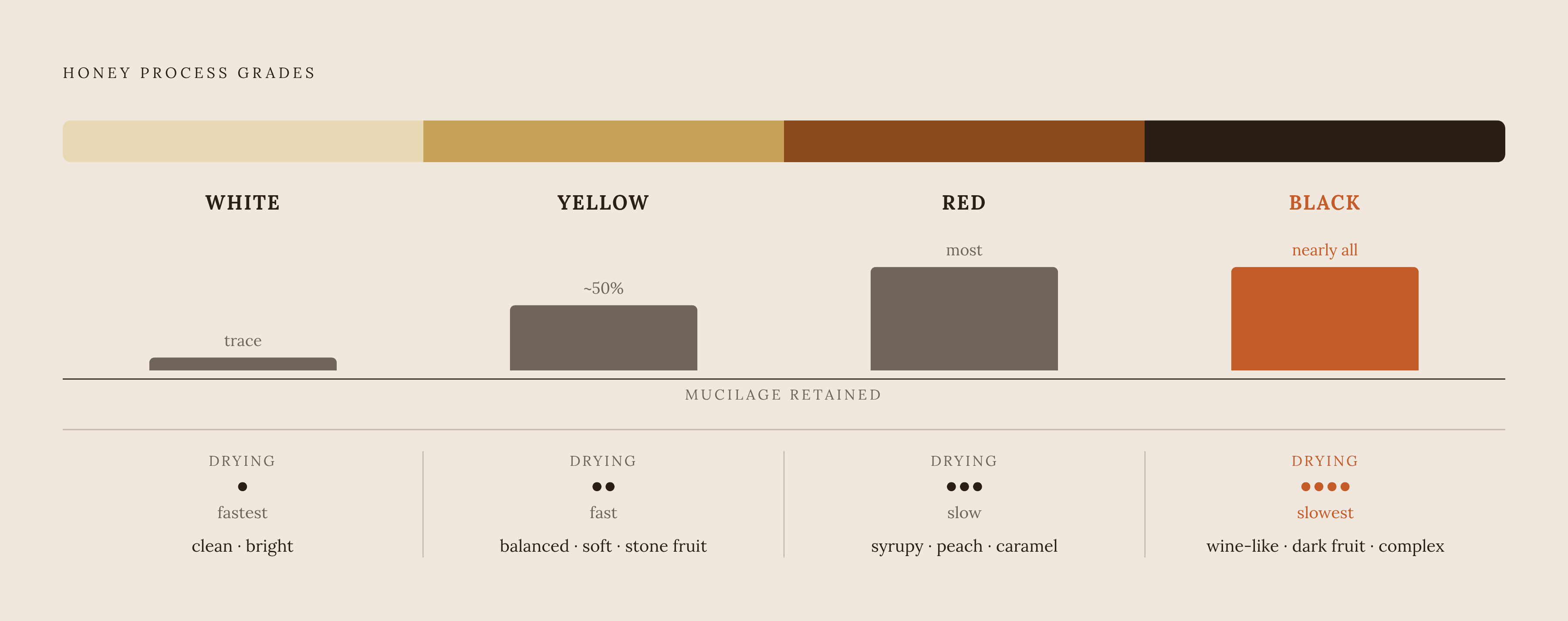
The honey colors broadly show how much mucilage stays on the bean and how slowly it dries. As mucilage oxidizes and ferments, the drying parchment becomes darker, with corresponding changes in flavor. The color is not simply a cosmetic difference. It signals the conditions under which the bean dried, although mills do not all create those conditions in the same way.
White honey retains very little mucilage and dries fastest. It sits closest to washed coffee, with a clean, bright, lightly sweet profile. Yellow honey can retain roughly half the mucilage, depending on the mill’s convention, and generally offers balanced sweetness, mild stone fruit, and a soft, round body. Its acidity is brighter than that of red or black honey. These lighter categories preserve more of the clean character associated with washed processing.
Red honey retains most of the mucilage and dries more slowly. Its profile becomes fuller and more syrupy, with riper stone fruit, caramel, and peach or apricot character. Black honey generally retains nearly all the mucilage and undergoes the slowest drying. It produces the heaviest body and greatest sweetness, with complex, wine-like dark fruit that approaches natural processing. It is also the hardest category to execute without defects.
There is no industry-wide rule for where yellow ends and red or black begins, and some mills use how the beans dry as their criterion for telling them apart. The practical reading is therefore directional. A color suggests a likely profile, but the producer’s account of retention and drying gives that suggestion its precision.
What honey process tastes like across the spectrum, compared to washed and natural
Honey processing combines syrupy sweetness with fruit character and a substantial body. Its distinction is not simply that it falls halfway between washed and natural coffee. Fruit contact without whole-cherry drying creates its own balance of richness and clarity. Aromas commonly include stone fruit, berries, caramel, and brown sugar, with occasional floral notes toward the yellow end. The cup can feel rich without fermented fruit taking over.
Washed coffee provides a useful contrast in texture. It typically has light to medium body, high and bright acidity, and clean, precise sweetness, often expressed through citrus and florals. Without mucilage during drying, its profile is more terroir-forward. Honey coffee usually has medium to full body and medium acidity, with richer sweetness and notes of caramel, stone fruit, and red fruit. Compared with a washed coffee from the same farm, it often offers more body and sweetness.
Whole-cherry drying typically produces full, heavy body, low to medium acidity, and bold sweetness that can become jammy or wine-like. It often has notes of berries and tropical fruit, along with fermented character. Honey processing can offer an accessible alternative for drinkers who find that intensity excessive. Its fruit sweetness often comes without the fermented edge, though black honey can be nearly as intense as natural coffee.
Within honey coffee, yellow emphasizes delicate florals, citrus, and clean sweetness. Red shifts toward peach, apricot, caramel, and balanced acidity, making it a particularly crowd-pleasing expression. Black moves into dark fruit, preserves, molasses, and wine-like depth, which may challenge drinkers unfamiliar with natural-style profiles. This range also explains why many drinkers enjoy honey coffees without milk or sugar. Their inherent sweetness gives the cup enough richness without additions.
Processing turns a ripe coffee fruit into a green bean ready for roasting by removing its layers, including skin, pulp, mucilage, and parchment.
Where honey process comes from and why Costa Rica pioneered it
Costa Rica pioneered honey processing in the late 2000s as small micro-mills sought to conserve water and distinguish their coffees. Water was scarce, which gave mills a reason to change how they processed coffee. Leaving mucilage on the bean saved the water that washed processing uses in fermentation tanks and washing. Yet conservation was not the only motivation. The method also offered more sweetness and body than washed coffee, with greater structure and control than whole-cherry drying.
Tarrazú, the Central Valley, and the West Valley became known for their honey coffees. Within the Central Valley, Las Lajas illustrates how control begins before depulping. Oscar and Francisca Chacon are third-generation farmers and recognized pioneers of honey and natural processing. They measure the cherries’ natural sugar content, known as brix, to determine when to pick. Harvesting begins when the reading reaches approximately 22°.
Beneficio San Diego represents a different production arrangement in Tarrazú. A community of smallholder farms averaging three hectares each delivers cherries to a central wet mill. Lots are selected according to farm condition and cherry ripeness at harvest. Here, selection connects the work of separate farms to processing at the mill. The producer story therefore includes both where the fruit grew and how the mill selected it.
Honey processing later spread beyond the regions of Costa Rica where coffee grows. El Salvador, Panama, Honduras, Nicaragua, and Guatemala produce notable honey lots, while Brazil produces the closely related but distinct pulped natural method. Ethiopia is an emerging market for honey processing in specialty coffee.
How importer relationships and traceability make the honey spectrum legible to buyers
A “red honey” label becomes useful when its production history is available. Without an official standard, its meaning depends on who produced the coffee and what the supply chain communicates. Knowing the mill, the producer, and the drying approach turns a broad category into more specific flavor information. A farm name provides the starting point. The lot’s processing details explain what happened to its fruit after harvest.
Importers with direct relationships to mills can preserve that detail. They can pass drying time, mucilage percentage, farm altitude, and harvest date to roasters, who can then communicate it to buyers. Mucilage percentage shows how much was left on the bean, while drying time helps explain how that layer was handled. Together, they make the color label easier to interpret.
A roaster’s knowledge of its farms and importers determines how much processing information survives the journey to the consumer. When that relationship brings buyers details about each lot, they can tell how coffees with the same color name differ. Where it does not, the label remains only a broad guide to likely sweetness, body, and fruit intensity.
How roast level shapes what the mucilage-derived flavor becomes in the cup
Light and medium roasts show honey coffee’s sweetness most clearly, allowing stone fruit, florals, and caramel to remain legible. Darker roasting can mask those qualities with roast-derived bitterness. That shift works against the reason for choosing honey processing when the intended result is distinctive fruit sweetness.
Small-batch roasting gives the roaster room to adjust development. Slowing development, tapering heat, or changing airflow in real time can protect the delicate aromatics produced through honey processing. Large-scale commercial roasting uses standardized profiles because changing the roast midway through in a much larger drum can have results that are hard to predict.
The Probat’s classic drum design offers heat stability and airflow precision suited to consistent light and medium roasting. A burner heats a rotating drum, and the beans receive heat from both the metal surface and moving air. Freshness then becomes the next constraint on aroma. Roasting often and shipping quickly help stone fruit and floral aromatics reach the brewer before they fade while the coffee is stored.
Brewing honey process at home: method choices that match the flavor profile
For home brewing, the useful choice is which quality to emphasize. Honey coffees respond well across methods, but clarity, body, and concentrated sweetness do not come forward equally in each one. Pour-over brings out delicate stone fruit and floral notes. It is particularly well suited to yellow and red honey, where a clear presentation can preserve both fruit definition and sweetness. Yellow and red are also the easiest starting points for drinkers new to the spectrum.
AeroPress favors a richer, more concentrated expression of sweetness. Its combination of immersion and pressure works well with honey coffee, whether brewed with the standard or inverted method. Espresso is especially well suited to red and black honey. Pressure and concentration amplify caramel, dark fruit, and the syrupy body associated with greater mucilage retention. Black honey also holds up well under milk.
Cold brew offers another route to accessible sweetness. Cold brew’s long steep in room-temperature or cold water makes a smooth, low-acid concentrate, and honey coffee’s natural sweetness is still easy to taste when it is cold. The method therefore suits a drinker seeking sweetness without emphasizing bright acidity. Whatever the brewing method, a slightly coarser grind than the one used for washed coffee can help honey coffees avoid over-extraction.
Yellow honey has clarity and gentle sweetness, while red has a fuller, caramel-and-stone-fruit profile without black honey’s wine-like intensity. Honey process is forgiving and crowd-pleasing enough that understanding the spectrum can guide a purchase without turning the first cup into a production exercise.
This article is sponsored by Hollowbrook Roasters.