Essay Coffee Origins
Ethically Sourced Single-Origin Coffee Online Buying Guide
How to verify ethical sourcing claims through farm names and supply chain records.
Sponsored by Hollowbrook Roasters
Buying ethically sourced single-origin coffee online depends on evidence. The clearest signal is how specifically a roaster can identify the farm, process, importer, and production cycle behind the bag. This guide explains how to read those disclosures, judge what certifications establish, and use freshness and flavor as supporting checks on the sourcing claim.
Why "single-origin" and "ethically sourced" are not self-proving claims
“Single-origin” and “ethically sourced” appear across price tiers, but neither term has a legal definition or mandatory verification standard. Their credibility therefore depends on the details a roaster supplies. The words alone establish very little about accountability. A bag labeled “Brazil single-origin” may contain beans aggregated from dozens of unrelated farms across vast distances, even though its country of origin is accurately stated.
Phrases such as “responsibly sourced” and “ethically traded” offer no way to assess a purchase unless documentation gives them substance. Named farms, cooperatives, altitudes, and processing methods make the description more specific, while records connecting those details make it verifiable. Specificity provides evidence for examining claims of ethical conduct.
For an online buyer, this changes the task. Reading a product page for appealing tasting notes is different from reading it for accountability. The useful questions concern who produced the coffee, how it reached the roaster, and what supports the ethical claim. By applying those questions, a buyer can distinguish a documented sourcing relationship from a bag that merely uses the right vocabulary.
What traceability actually requires at each step of the supply chain
Traceability begins with the producer and continues through the processing station, importer, and roaster. Each link must be nameable and verifiable. A detailed farm story cannot compensate for an anonymous route to the roaster, just as a named importer cannot identify an otherwise unspecified producer. The chain is only as informative as its connected disclosures.
At the production end, useful specificity progresses from country to region, then to a washing station or cooperative, and finally to a named farm or producer. Yirgacheffe or Huila narrows the geographic claim. A farm name, sometimes preceded by “Finca,” or the name of a lead farmer identifies responsibility more precisely. A named varietal such as Bourbon, Typica, or Geisha adds information about the coffee itself, while altitude in meters sharpens the production description. Neither replaces the producer’s identity.
Further along the chain, a named importer exposes a relationship that can be audited between the farm and roaster. Documents can support that relationship beyond the label. The ICO Certificate of Origin lets professionals check the coffee’s origin, and they can compare it with the Bill of Lading and invoices. Annual transparency reports containing producer names and farmgate prices extend that evidence into purchasing terms. On a roaster’s website, harvest year, altitude, and Free on Board (FOB) price provide more substance than tasting notes repeated across a sourcing page.
How processing method fits into the traceability picture
Processing explains a major difference that origin alone cannot. The same bean from the same farm can taste entirely different depending on how it was processed. Omitting the method therefore leaves a gap in both the production account and the flavor description. A named method connects what happened after harvest to what the bag promises.
Washed coffee is depulped, fermented in water, and thoroughly washed before drying. Removing the fruit influence gives bright acidity and floral notes a clearer expression of terroir. Natural coffee, by contrast, dries with the whole cherry intact over weeks, developing bold, jammy, wine-like character as fruit sugars ferment into the bean. Sweetness becomes more prominent, while terroir clarity softens. Honey processing sits between these approaches, with the skin removed and varying amounts of sticky mucilage left during drying.
Red honey retains more mucilage for sweetness and fuller body, while yellow honey removes more for a profile closer to washed coffee. Buyers who want to check further can ask whether honey classifications refer to mucilage percentage or color, whether the coffee dried on African raised beds or concrete patios, and whether fermentation was dry or wet and how long it took. The answers should explain the coffee.
What certifications verify and where they stop
Certifications provide audited, independently verifiable evidence, but each addresses a different part of ethical sourcing. No single certification fully covers farmer income, environmental stewardship, and supply-chain transparency on its own. A certification is useful when its requirements answer the question being asked of it.
Fair Trade sets a minimum price floor to protect farmers when the market crashes. It also mandates community development investment and democratic cooperative governance, with independent auditing that makes those requirements verifiable. Its environmental requirements establish a baseline for sustainability. Premiums can also be smaller than the returns farmers earn through direct relationships.
Rainforest Alliance focuses on biodiversity protection, water management, and worker safety. It relies on market mechanisms rather than price floors, so it does not guarantee living wages. Organic certification answers a different question by verifying the absence of synthetic pesticides, herbicides, and fertilizers and supporting long-term soil health. It does not address labor practices or farmer income. An organic coffee can still come from a farm with underpaid workers.
Direct trade is a relationship model. Buying directly from a farm or cooperative can remove middlemen, leave farmers with more value, and support predictable long-term income, but the claim has no independent audit. Its credibility rests on what the roaster publishes. Certification establishes requirements met at the time of audit, while named producers, purchasing records, and disclosed prices show which relationships stand behind the bag.
Named farms, cooperatives, altitudes, and processing methods make the description more specific, while records connecting those details make it verifiable.
Regional flavor profiles as a cross-check on origin claims
Origin and process together create a flavor expectation. That expectation is useful as a cross-check on records. A mismatch may indicate a loose sourcing claim, a roast that obscures origin character, or an expectation that needs adjusting.
Kenya’s Nyeri and Kirinyaga regions provide a useful reference for blackcurrant and wine-like acidity in coffees that are almost always washed. Their profiles should not be treated as identical. Kirinyaga can show medium-to-full body with a juicy, round mouthfeel, while tomato and savory complexity is more pronounced in Nyeri’s top lots. These distinctions help make a regional description more discriminating than a broad national flavor claim.
Processing adds another condition to that comparison. A washed Ethiopian and a natural Ethiopian from the same farm are not interchangeable because natural processing amplifies sweetness and softens clarity. A buyer expecting Yirgacheffe florals from a natural lot may therefore misread a legitimate processing difference as an origin problem. For a bag labeled Yirgacheffe washed, however, an earthy, low-acid cup warrants questions about origin, processing, or roast. A floral, bright cup makes the description plausible, though it does not verify the supply chain.
How freshness and roast date connect to traceability
A roast date shows which production cycle the coffee came from. It also gives the buyer a basis for judging when the coffee should show its most expressive flavors. A generic best-by date does neither because it does not disclose when roasting happened. Naming the farm while withholding the roast date leaves the production record incomplete.
This gap is particularly consequential for single-origin coffee. Fruit, floral, and terroir notes fade first, so freshness affects whether the origin description remains perceptible at all. Stale coffee loses the distinctions that justified choosing a particular source.
Beans roasted within the last two weeks bloom visibly during pour-over brewing, while very old beans barely bloom. That response gives the buyer a check on packaging language to compare with the disclosed date. The bloom is a supporting freshness signal. Its role in the audit is narrower but still useful.
Reading a coffee bag label as a traceability audit
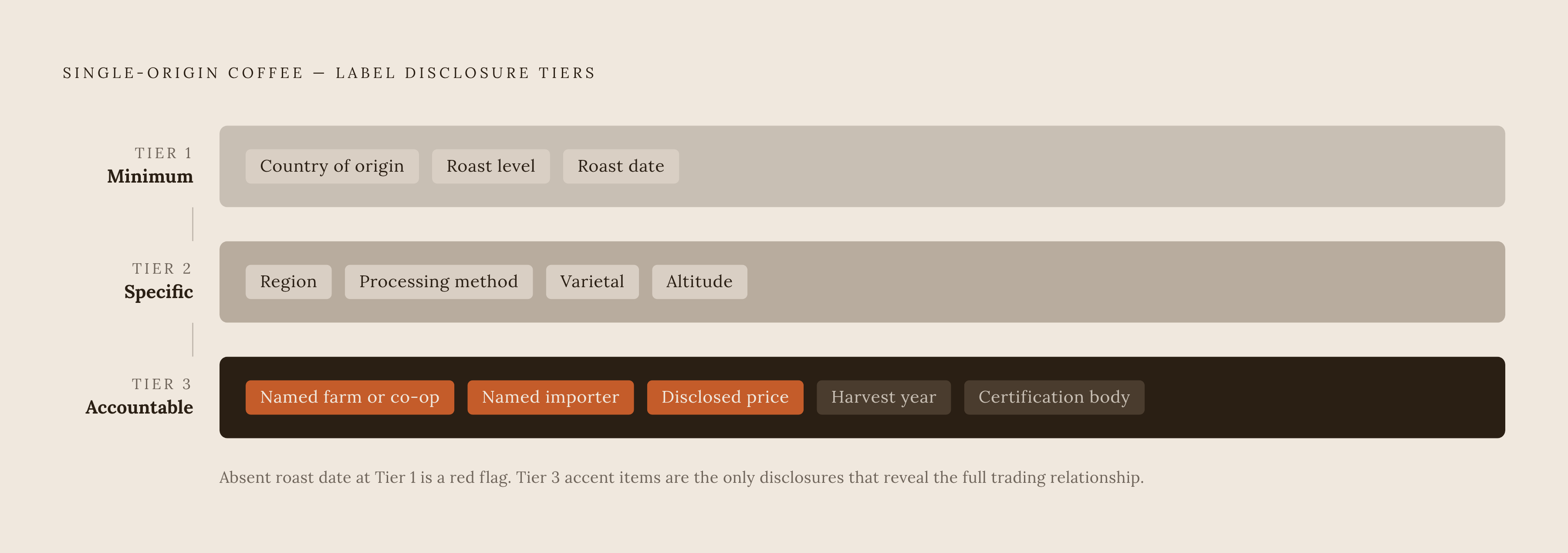
Tier 1 consists of country of origin, roast level, and a roast date, required even when a best-by date is provided. An absent roast date is already a flag. A country name alone does not justify treating the bag as meaningfully traceable.
Tier 2 also names the region, processing method, varietal, and altitude. A label that names Yirgacheffe, washed processing, and a varietal gives the buyer more specific claims to check than a broad origin category does. Each detail has a separate purpose. Region locates production, processing explains flavor development, and varietal and altitude sharpen the description. Together, they make the product account more useful, though they still do not reveal the full trading relationship.
Tier 3 adds the strongest accountability disclosures, including a named farm or cooperative, named importer, harvest year, farmgate or FOB price, and certification with its certifying body identified. The producer and importer connect the ends of the sourcing relationship. Harvest and price information add production and purchasing context. Certification then contributes evidence within its particular scope.
Sourcing pages with harvest year, altitude, and FOB price supply evidence that a small bag may not accommodate. Warning signs include a best-by date in place of the roast date, a bag sold at specialty-tier prices that names only the country of origin, and certification logos that name neither the certifying body nor the farm it certified.
Where disclosures stop, direct questions are legitimate. Buyers can ask for records of the coffee’s origin and ask whether the roaster publishes annual transparency reports with producer names and farmgate prices. Asking for an ICO Certificate of Origin or records of purchases goes further than reading the label, but it helps buyers check the sourcing claim in the same way. Buyers who ask specific questions give roasters a direct reason to make their sourcing claims accountable.
Matching origin and process to brew method so the sourcing investment pays off at home
Once the sourcing evidence gives buyers grounds to buy the coffee, how they brew it affects how clearly they can taste its promised character. Matching the method to the origin and process provides a practical starting point. Pour-over suits washed coffees built on clarity. Cold brew suits naturally processed coffees built on sweetness and body.
For washed Ethiopian or Kenyan coffees, pour-over can reveal floral and bright-acid notes that espresso concentrates into intensity and French press masks with sediment. A medium to medium-fine grind is the appropriate starting range. Too fine risks bitter, astringent over-extraction, while too coarse risks a sour, weak result. Water at 90–96°C (195–205°F) helps with extraction, but cooler water can lead to under-extraction and hotter water to over-extraction. During the bloom, escaping CO₂ allows water to contact the grounds more evenly.
For cold brew, a 12–24-hour steep makes a smooth, low-acid concentrate that works well with the bold fruit and chocolate sweetness of naturals and full-bodied origins such as Brazilian lots. It also suits drinkers who find washed single-origins too bright when served cold. The aim is not the same clarity sought in washed pour-over coffee, but a brewing choice consistent with the coffee’s sweetness and body.
For either method, grinding immediately before brewing preserves volatile aromatics that express origin character. Pre-ground coffee loses those aromatics quickly. Brewing within one to three weeks of the roast date gives single-origin flavors their most expressive window, before those distinctions fade. Buying traceable coffee and brewing it attentively are connected acts, with the production record explaining where the flavor comes from and the brew allowing that origin to remain legible.
This article is sponsored by Hollowbrook Roasters.